
How to use
Pick a “Date of birth” and all three ages appear together. “Reference date” starts out as today’s date on the device you are using. To see the ages on another day, change it to that date.
The largest number is “International age (man-nai)”. The line just below it tells you whether international age and year age match. If the reference date is the birthday itself or later in that year, it reads “The reference date is on or after that year’s birthday, so international age and year age are the same.” If the birthday is still ahead, it reads “The reference date is before that year’s birthday, so international age is one year less than year age.” Under that come “Year age (yeon-nai)” and “Counting age (se-neun-nai)”, a box titled “Which age is used for what”, and a link to the Korean Ministry of Government Legislation’s guide.
Korea’s three ages
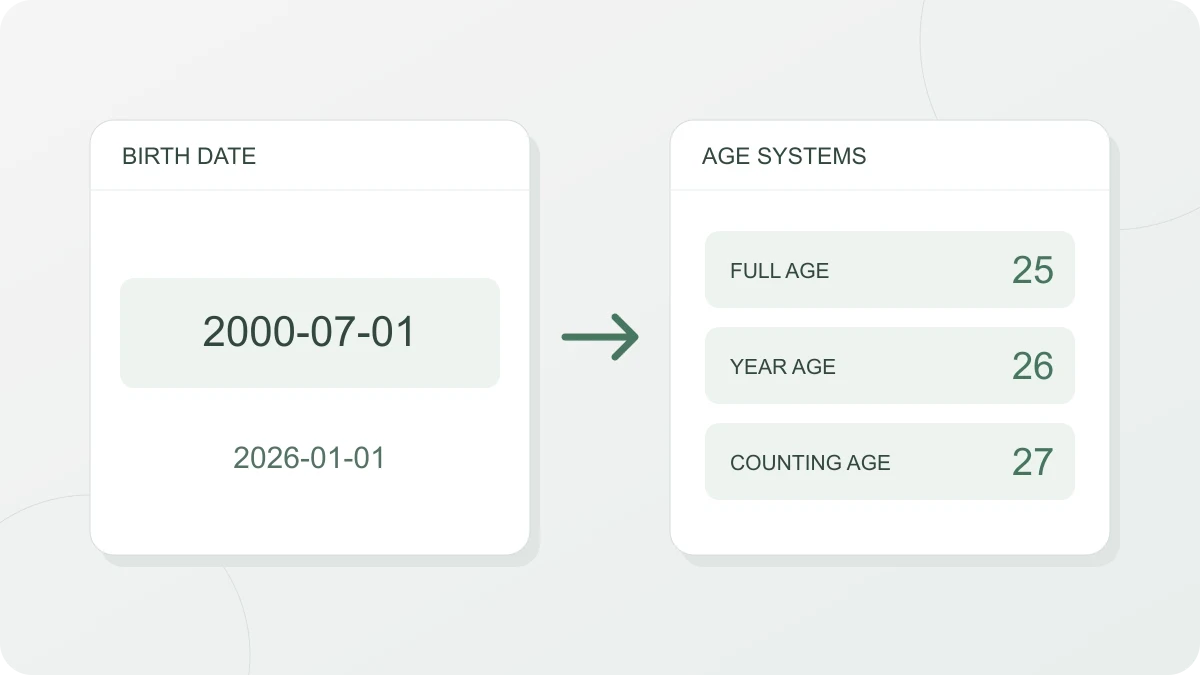
- International age (man-nai): you start at 0 on the day you are born and add a year on each birthday. This is what “age” normally means in other countries.
- Year age (yeon-nai): the year of the reference date minus the year you were born. It goes up on January 1 whatever your birthday is.
- Counting age (se-neun-nai): you are 1 the moment you are born and add a year every January 1. It is always year age plus 1. It is the age Koreans have used by custom in everyday life. An age written in a law, a contract or an official document is read as international age unless a specific provision says otherwise.
Year age is either equal to international age or one higher, and counting age adds one more on top of that. So going from counting age to international age takes off one year if you have already had your birthday this year, and two if you have not.
Worked examples
With the reference date set to September 28, 2026, the three ages are:
| Date of birth | International age | Year age | Counting age |
|---|---|---|---|
| March 15, 1990 (birthday passed) | 36 | 36 | 37 |
| December 10, 2000 (before birthday) | 25 | 26 | 27 |
The gap feels widest for a baby born at the very end of the year. On January 1, 2026, a baby born on December 31, 2025 is only on their second day of life, yet already has an international age of 0, a year age of 1 and a counting age of 2.
The days the ages change
International age changes on your birthday. Year age and counting age change on January 1. Moving the reference date forward for someone born on December 10, 2000 shows it:
| Reference date | International age | Year age | Counting age | What changed |
|---|---|---|---|---|
| December 9, 2026 | 25 | 26 | 27 | Nothing |
| December 10, 2026 | 26 | 26 | 27 | International age (birthday) |
| January 1, 2027 | 26 | 27 | 28 | Year age and counting age (New Year) |
International age and year age match from your birthday until December 31 of that year. The closer your birthday is to the start of the year, the more days the two agree. Someone born in December spends most of the year with a one-year gap.
Typical cases where year age is used
- Buying alcohol and tobacco: the Juvenile Protection Act treats anyone under 19 in international age as a juvenile, but leaves out people who have reached January 1 of the year they turn 19. In practice you can buy them from January 1 of the year your year age becomes 19. In 2026 that means anyone born in 2007 or earlier.
- Military service: the Military Service Act kept year age for the ages tied to military duty even after the switch to international age. An age written in that act applies from January 1 of the year you reach it.
When you are checking rules like these, read “Year age (yeon-nai)” in the result. Individual laws can be amended and the rule may change with them, so confirm anything important against the current law.